
Excerpt from; Stamp Duty Land Tax Guide For Property Investors.
- Calculating SDLT Liability
- —
- New Lease Agreements
- Stamp Duty Land Tax (SDLT) on a Premium
- SDLT on Rent
- Effect of Rent Increases in the First Five Years of a Lease
- Calculation of NPV and SDLT
- Using the HMRC SDLT Calculator
- Connected Company Rule
- Linked Transactions
- Linked Transactions in Lease Agreements
- Other Linked Leases
- Lease Renewals and Extensions
- SDLT and Lease Renewal
- Execution and SDLT Obligations
- SDLT on Old Leases
- New Lease Granted After Expiry of Old Fixed-Term Lease
- New Lease Superseding Old Lease for Indefinite Term
- New Lease Superseding Old Lease for Indefinite Term
- Stamp Duty Land Tax (SDLT) on New Leases
- Grant of New Lease Before Expiry of Old Lease
- New Lease Granted After Expiry of Old Fixed-Term Lease
- Lease Examples
- Calculating SDLT Liability
Calculating SDLT Liability
(SDLT and Leases)

| Comment: Calculating Stamp Duty Land Tax (SDLT) liability on leases can be complex, involving various considerations such as rent, premiums, and specific tax treatments.
Key Points
Main Principles
|
What is Consideration?
SDLT is charged on ‘chargeable consideration,’ defined as any consideration in money or money’s worth given by the purchaser or a connected person. For leases, consideration may be in the form of rent and/or a premium. Distinguishing between rent and premium is essential due to their different tax treatments.
- Non-cash Consideration: The usual valuation rules apply.
- Foreign Currency Consideration: The same valuation rules apply.
- Exemptions: Limited exemptions include carrying out works or transactions qualifying for ‘PFI relief.’
Surrendering and Granting Leases
When a lease is surrendered in exchange for another lease, the surrender and grant do not count as consideration for each other. Accepting normal tenant obligations, other than rent and premium payment, is not considered when granting a lease.
Understanding Rent in Lease Agreements and SDLT Implications
Rent, although not comprehensively defined, typically refers to periodic payments made by a tenant for the use or occupation of a property. Here are key considerations regarding rent and its treatment under SDLT (Stamp Duty Land Tax):
Definition and Valuation of Rent
- Periodic Payments: Rent generally involves regular payments made by the tenant to the landlord for occupying the property.
- Non-Sterling Cash Payments: If rent is payable in non-sterling currency, it must be valued at the ‘effective date’ of the lease, ensuring accurate SDLT calculations.
Inclusive Rents and Service Charges
Inclusive Rents: When a single sum is payable for rent and other matters (e.g., insurance, cleaning, maintenance), it should be apportioned to separate the rent from other items. This helps minimise SDLT liability by distinguishing between rent proper and additional services.
Service Charges: According to HMRC, service charges are not considered rent if they are:
- Provided for separately in the lease.
- Part of an inclusive rent payment but apportioned on a just and reasonable basis.
Example: Amount of Rent Chargeable to SDLT
Scenario: On June 1, 2022, Emily leases an office space in a commercial building from City Properties Ltd on a ten-year lease, terminable with one year’s notice. The annual rent is £40,000, which includes a proportionate share of the building’s insurance premium. Additionally:
- The rent covers heating, air conditioning, and cleaning services, although these amounts are not explicitly allocated in the lease.
- Light and power are separately metered and charged to Emily.
SDLT Implications:
- Insurance Premium: The clearly identified insurance premium, representing the actual cost, will not count towards the rent for SDLT purposes.
- Non-Allocated Services: The rent for heating, air conditioning, and cleaning services, which are not allocated in the lease, is considered entirely as rent for SDLT purposes.
To avoid higher SDLT liability, the parties should specify a reasonable allocation of these service costs within the lease. Even without explicit numbers, HMRC may accept a reasonable apportionment, possibly requiring evidence from City Properties Ltd to support non-chargeable amounts.
Anti-Avoidance Provision
To prevent avoidance tactics, there is an anti-avoidance provision in place. This provision ensures that premiums are not disguised as rent to reduce SDLT liability. Key points include:
- Loan or Deposit: If a tenant pays a loan or deposit that exceeds a normal ‘rent deposit,’ it is taxed as a premium, even if it is repayable. This typically involves offsetting the deposit against future rent payments.
Practical Steps
- Lease Clarity: Ensure the lease clearly distinguishes between rent and other service charges. Specify and apportion any inclusive payments to reflect their true nature.
- Valuation Evidence: Maintain documentation and evidence to support any apportionment of rent and service charges. This can help in case of queries from HMRC.
- Consultation: Seek advice from legal and tax professionals to ensure compliance with SDLT regulations and to optimise tax liabilities.
—
New Lease Agreements
(SDLT and Leases>Calculating SDLT Liability)
➤ Calculate SDLT separately for rent and premium, include VAT, then add both amounts to find the total liability.
When a new lease is granted or deemed to be granted, Stamp Duty Land Tax (SDLT) must be calculated separately on any rent and on any premium or deemed premium. The two components are then simply added together to determine the total SDLT liability. Here are the key points to consider:
Calculation Components:
- SDLT must be calculated separately for both rent and any premium or deemed premium.
- Both amounts are combined to determine the overall SDLT liability.
Inclusion of VAT:
- Any VAT chargeable must be included in both the rent and premium calculations.
- If the landlord exercises the ‘option to tax’ after the ‘effective date’ of the transaction, this VAT does not need to be included in the SDLT calculation.
Relevant Legislation
Finance Act 2003, Schedule 5:
- Details the requirement to calculate SDLT separately on rent and premium for new leases.
Finance Act 2003, Schedule 4, Paragraph 2:
- Provides guidance on the treatment of VAT in SDLT calculations, specifically addressing scenarios involving the ‘option to tax’.
Example Scenario
Consider a lease granted on July 15, 2024, with the following terms:
- Rent:
- £50,000 per year
- VAT applicable at 20%, included in the rent calculation
- Premium:
- £200,000 one-time payment
- VAT applicable at 20%, included in the premium calculation
In this scenario, the SDLT would be calculated as follows:
- Rent SDLT Calculation:
- Calculate the SDLT based on the annual rent of £50,000 plus 20% VAT (£10,000), resulting in a total of £60,000.
- Premium SDLT Calculation:
- Calculate the SDLT based on the premium of £200,000 plus 20% VAT (£40,000), resulting in a total of £240,000.
- Total SDLT Liability:
- Add the SDLT amounts calculated for the rent and premium to determine the overall SDLT liability.
By following these guidelines and considering the relevant legislation, you can accurately determine the SDLT liability for new lease agreements.
—
Stamp Duty Land Tax (SDLT) on a Premium
(SDLT and Leases>Calculating SDLT Liability)
➤ SDLT on premiums varies by property type and residency, with rates up to 15%, a 2% surcharge for non-UK residents, and specific conditions for first-time buyers and non-residential properties.
Overview
Stamp Duty Land Tax (SDLT) applies to premiums on property transactions. The rates and conditions for SDLT vary based on several factors including the type of property, the effective date of the transaction, and the residency status of the buyer. Below is a detailed explanation of the rates and rules applicable.
SDLT Rates for Residential Property
- Standard Rates: Up to 12% on a progressive basis.
- Higher Rates: Up to 15% on a progressive basis for additional dwellings and properties purchased by companies.
- Slab Rate: A flat rate of 15% in certain circumstances.
- Non-UK Resident Surcharge: An additional 2% applied to each of these rates for residential properties.
SDLT Rates for Non-Residential Property
- Standard Rates: Up to 5% on a progressive basis for lump sum payments.
- Historic Rates: For transactions with an effective date on or before 16 March 2016, a lease of non-residential property subject to rent of £1,000 or more per annum had a 1% rate for premiums up to £150,000. This rule was abolished for leases granted on or after 17 March 2016.
First-Time Buyer’s Relief
To qualify for first-time buyer’s relief, the ‘chargeable interest’ acquired must be a ‘major interest’ in a single dwelling:
- Major Interest: Includes the grant of a new lease.
- Exclusion: Leases with less than 21 years to run at the start of the day after the effective date of the transaction do not qualify.
Non-UK Resident Surcharge
- Effective from 1 April 2021: A 2% surcharge applies to premiums on the grant of leases over one or more dwellings for terms longer than 7 years if the transaction is a ‘non-resident transaction’.
- Exclusion: The 2% surcharge does not apply to leases for terms of 7 years or less.
Key Dates and Rules
- Transactions on or before 16 March 2016: Specific rules regarding rent and premiums for non-residential properties.
- Transactions on or after 17 March 2016: Updated rules for premiums on non-residential properties.
- 1 April 2021: Introduction of the 2% non-UK resident surcharge for certain leases.
—
SDLT on Rent
(SDLT and Leases>Calculating SDLT Liability)
➤ SDLT on rent is based on the lease’s annual rent, with estimates at the start and adjustments as actual amounts are determined.
Calculating SDLT on Rent
When calculating the Stamp Duty Land Tax (SDLT) on rent, it’s crucial to determine the annual rent amount for each year of the lease. The approach differs based on the length of the lease:
- Leases up to Five Years: For leases that are five years or shorter, the SDLT is calculated based on the actual rent paid each year.
Estimating Rent at Effective Date
If the actual rent amounts are not determined at the ‘effective date’ of the lease, an estimated SDLT must be paid. Key points to consider include:
- Effective Date Reference: Refer to sections 4.112 and 6.74 for the definition of the effective date.
- Reasonable Estimate Requirement: In the absence of exact figures, a reasonable estimate should be used for the initial SDLT payment.
Finalising SDLT Payments
Once the actual rent amounts are determined, further actions may be necessary:
- Additional Returns: Submit a further return if the initial estimate was incorrect, including any additional SDLT owed.
- Overpayment Reclaims: If the final figures show that the SDLT has been overpaid, you can submit an amendment to reclaim the overpayment. This step is optional but can be beneficial.
Example Scenario
Consider a lease agreement starting on January 1, 2023, with the following details:
- Lease Duration: 3 years
- Estimated Annual Rent: £12,000
At the effective date, the tenant pays SDLT based on the estimated annual rent of £12,000. By the end of 2023, the actual rent is determined to be £11,500. The tenant must then:
- Submit a further return indicating the revised rent.
- Pay any additional SDLT if the rent increases or reclaim if it decreases.
This process ensures that SDLT payments accurately reflect the actual rent amounts over the lease term.
—
Effect of Rent Increases in the First Five Years of a Lease
(SDLT and Leases>Calculating SDLT Liability)
➤ For the first five years of a lease, SDLT on rent adjusts based on any turnover-linked rent increases, calculated using net present value and specific thresholds.
Background of Lease Agreement:
- Parties Involved: John granted a ten-year lease of a bookstore to Alice.
- Lease Commencement: 1 January 2022.
- Initial Terms: The lease was executed on the start date without prior substantial performance, and no premium was payable. The initial rent is £8,000 per quarter, inclusive of VAT.
Rent Adjustment Clause:
- Turnover-Linked Increase: For any quarter in which the bookstore’s turnover exceeds £90,000, the subsequent quarter’s rent increases by one-tenth of the excess turnover.
Turnover and Rent Adjustments:
- First Five Years:
- Quarter Ending 31 March 2022: Turnover exceeded £90,000, resulting in the next quarter’s rent being adjusted to £9,500.
- Quarter Ending 30 September 2023: Turnover again exceeded £90,000, leading to the next quarter’s rent being set at £10,800.
- Remaining Quarters: Turnover did not exceed £90,000, so the rent remained at £8,000 per quarter.
Annual Rent Figures for SDLT Calculation:
- Year 1:
- Total Rent: £33,500 (Three quarters at £8,000 plus one at £9,500).
- Year 2:
- Total Rent: £34,800 (Three quarters at £8,000 plus one at £10,800).
- Years 3 to 5:
- Total Rent Each Year: £32,000 (Four quarters at £8,000).
- Years 6 to 10:
- Projected Rent: £34,800 per year, based on the highest annual rent from the first five years.
Calculation of SDLT Based on Rent Figures
Determining Rent for SDLT Purposes:
- The net present value (NPV) of the rent over the lease term must be calculated.
- The discount rate is specified by legislation (3.5% per FA 2003, Sch 5, paras 3, 8).
Calculation Methodology:
- Discounted Value:
- Rent for the first 12 months is divided by 1.035.
- Rent for the second 12 months is divided by (1.035)^2, and so on until the end of the lease term.
- Total Discounted Rent:
- The total of all discounted rent figures is calculated to determine if it exceeds the SDLT threshold.
SDLT Thresholds and Liabilities:
- Non-Residential or Mixed-Use Property:
- Threshold: £150,000.
- Residential Property:
- Threshold: £125,000 (with temporary increases to £500,000 and £250,000 for specified periods).
Practical Implementation:
Use of HMRC Calculator:
- An SDLT calculator is available on the HMRC website.
- Input must be accurate to avoid errors, as HMRC holds taxpayers responsible for incorrect data entry.
Key Considerations:
- Retain a copy of the SDLT calculation output for future reference.
- Ensure a full understanding of the transaction details when entering data into the calculator to avoid mistakes.
—
Calculation of NPV and SDLT
(SDLT and Leases>Calculating SDLT Liability)
➤ To calculate SDLT, determine the lease’s effective date, calculate net present value of the rent using a discount rate, and apply SDLT rates to the taxable amounts derived from the discounted rent and premium.
On 1 June 2022, Alice agrees to grant Bob a ten-year lease of an office building at an annual rent of £30,000 including VAT and for a premium of £300,000. There is an upwards-only rent review on the fifth anniversary. The lease is granted on 1 August 2022 without previously having been substantially performed. The ‘effective date’ is therefore 1 August 2022, and the rent review is due on 1 August 2027.
Calculation of NPV
Net Present Value (NPV) is a method used to determine the current value of a series of future cash flows. It considers the time value of money, discounting future amounts to reflect their present worth. Here’s how you can calculate NPV:
- Identify the cash flows: List all future cash inflows and outflows associated with the investment.
- Determine the discount rate: This could be the cost of capital, required rate of return, or interest rate.
- Discount the cash flows: Apply the discount rate to each future cash flow to calculate its present value.
- Sum the present values: Add up all the discounted cash flows to get the NPV.
Example Calculation
Given the details:
- Annual rent: £30,000
- Premium: £300,000
- Discount rate: 3% (example rate)
The NPV calculation involves discounting each year’s rent:
Rent Schedule
- Year 1
- Actual Rent: £30,000
- Discounted Rent: £29,126
- Year 2
- Actual Rent: £30,000
- Discounted Rent: £28,277
- Year 3
- Actual Rent: £30,000
- Discounted Rent: £27,453
- Year 4
- Actual Rent: £30,000
- Discounted Rent: £26,652
- Year 5
- Actual Rent: £30,000
- Discounted Rent: £25,875
- Year 6
- Actual Rent: £30,000
- Discounted Rent: £25,120
- Year 7
- Actual Rent: £30,000
- Discounted Rent: £24,388
- Year 8
- Actual Rent: £30,000
- Discounted Rent: £23,676
- Year 9
- Actual Rent: £30,000
- Discounted Rent: £22,985
- Year 10
- Actual Rent: £30,000
- Discounted Rent: £22,313
- Total Discounted Rent: £255,865
–
Excel Formula
To calculate NPV in Excel, you can use the NPV function:
=NPV(discount_rate, cash_flow_range) + initial_investment
For this example:
=NPV(3%, B2:B11) + B1
Where:
- 3% is the discount rate
- B2:B11 is the range of annual rents
- B1 is the premium
Calculation of SDLT (Stamp Duty Land Tax)
The SDLT can be calculated manually as follows:
- Identify the effective date: 1 August 2022.
- Determine the rent for SDLT purposes: Calculate the discounted rent using a suitable discount rate.
- Apply the zero-rate band and appropriate tax rates:
- Annual rent: £30,000
- Total discounted rent: £255,865
- Less zero-rate band: £150,000
- Taxable amount: £105,865
SDLT Calculation Steps
- SDLT on rent:
- 1% on £105,865 = £1,058.65
- SDLT on premium:
- £300,000 (£150,000 at 0% + £150,000 at 2%)
- 2% on £150,000 = £3,000
- Total SDLT (on rent and premium):
- £1,058.65 (rent) + £3,000 (premium) = £4,058.65
This comprehensive breakdown explains how to calculate NPV and SDLT for a lease agreement using provided values and formulas.
—
Using the HMRC SDLT Calculator
(SDLT and Leases>Calculating SDLT Liability)
➤ Use the HMRC SDLT calculator accurately by understanding the transaction, following the steps carefully, and keeping detailed records for compliance and future reference.
Recommendation
- Utilise the Tool: For most transactions, it is recommended to use the SDLT calculator available on the HMRC website.
- Accuracy is Key: Ensure accurate information is input to avoid errors. Retain a copy of the output for future reference.
Important Notes
- Understand the Transaction: Make sure you fully understand the nature of the transaction when entering information into the SDLT calculator.
- Maintain Detailed Records: Keep detailed records to support the SDLT calculations and submissions. This documentation is crucial for future reference and compliance.
Steps for Calculation
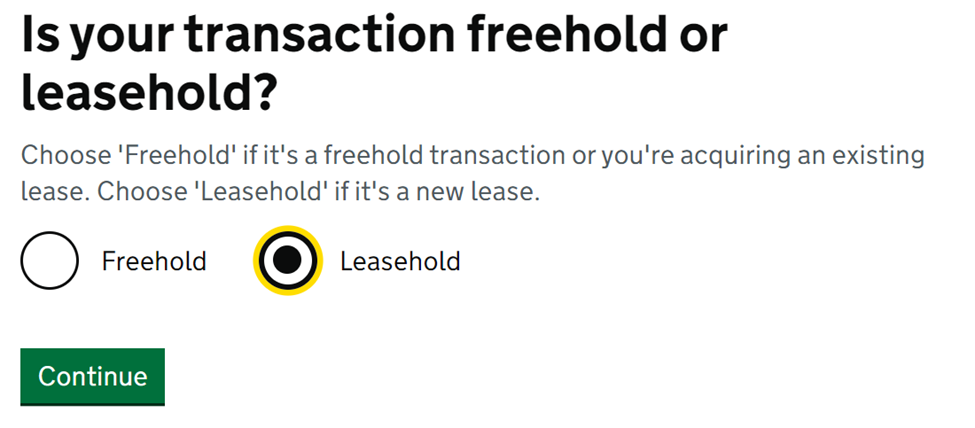
First Screen
Select Transaction Type:
- Choose ‘Leasehold’ for the transaction type.
- Click ‘Continue’.
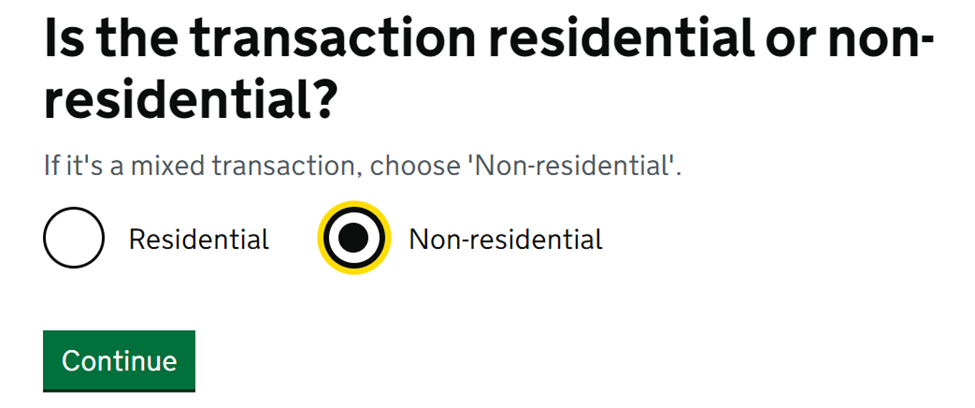
Second Screen
Select Property Type:
- Choose ‘Non-residential’ as the property type.
- Click ‘Continue’.
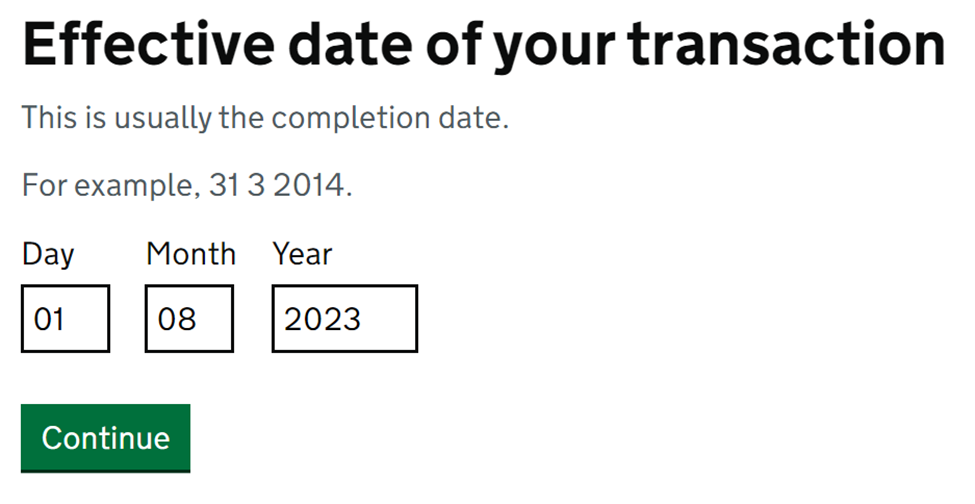
Enter Effective Date:
- Enter the effective date, for example, 1 August 2023.
- Click ‘Continue’.
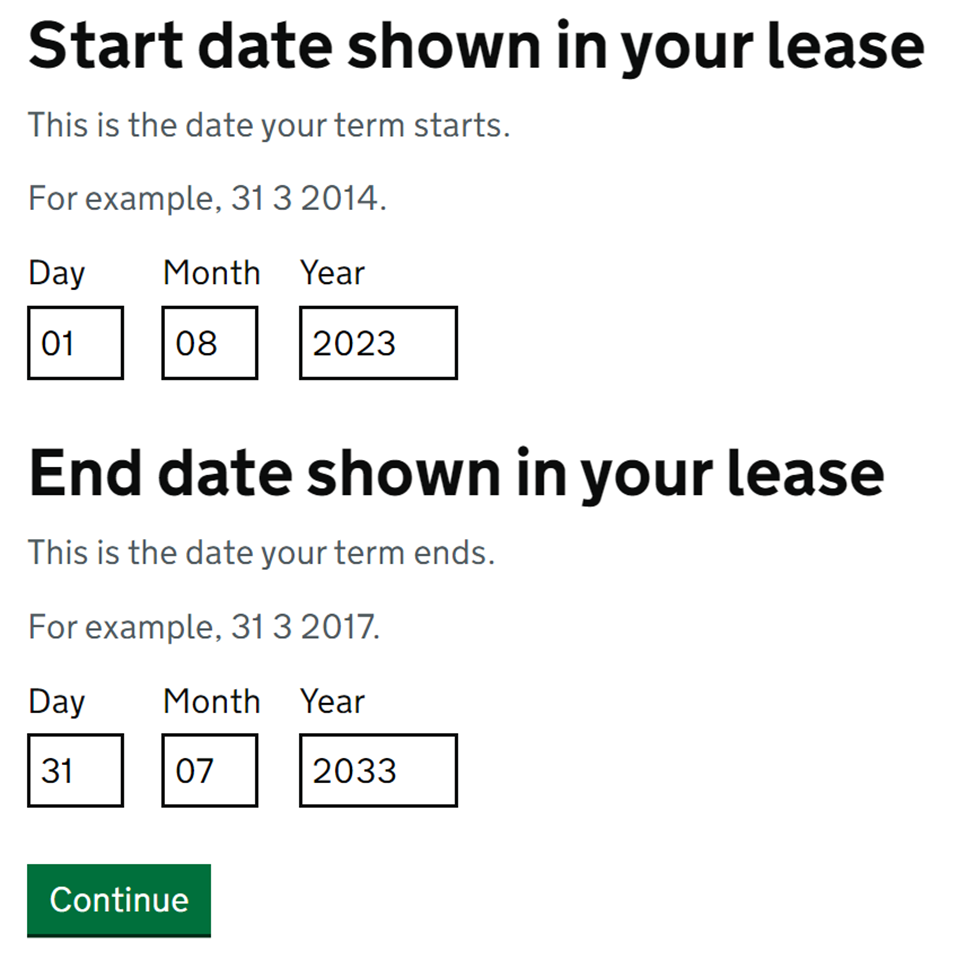
Enter Lease Dates:
- On the ‘Lease Dates’ screen, input the lease start and end dates. For instance, start date: 1 August 2023, end date: 31 July 2033.
- Click ‘Continue’.
Enter Premium Amount:
- On the ‘Lease Premium’ screen, enter the premium amount. For example, £50,000.
- Click ‘Continue’.
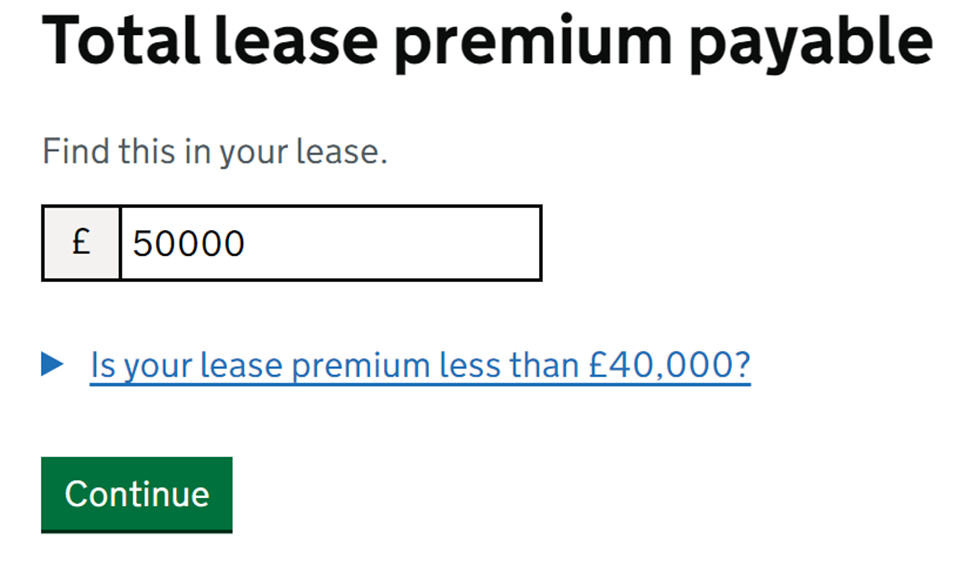
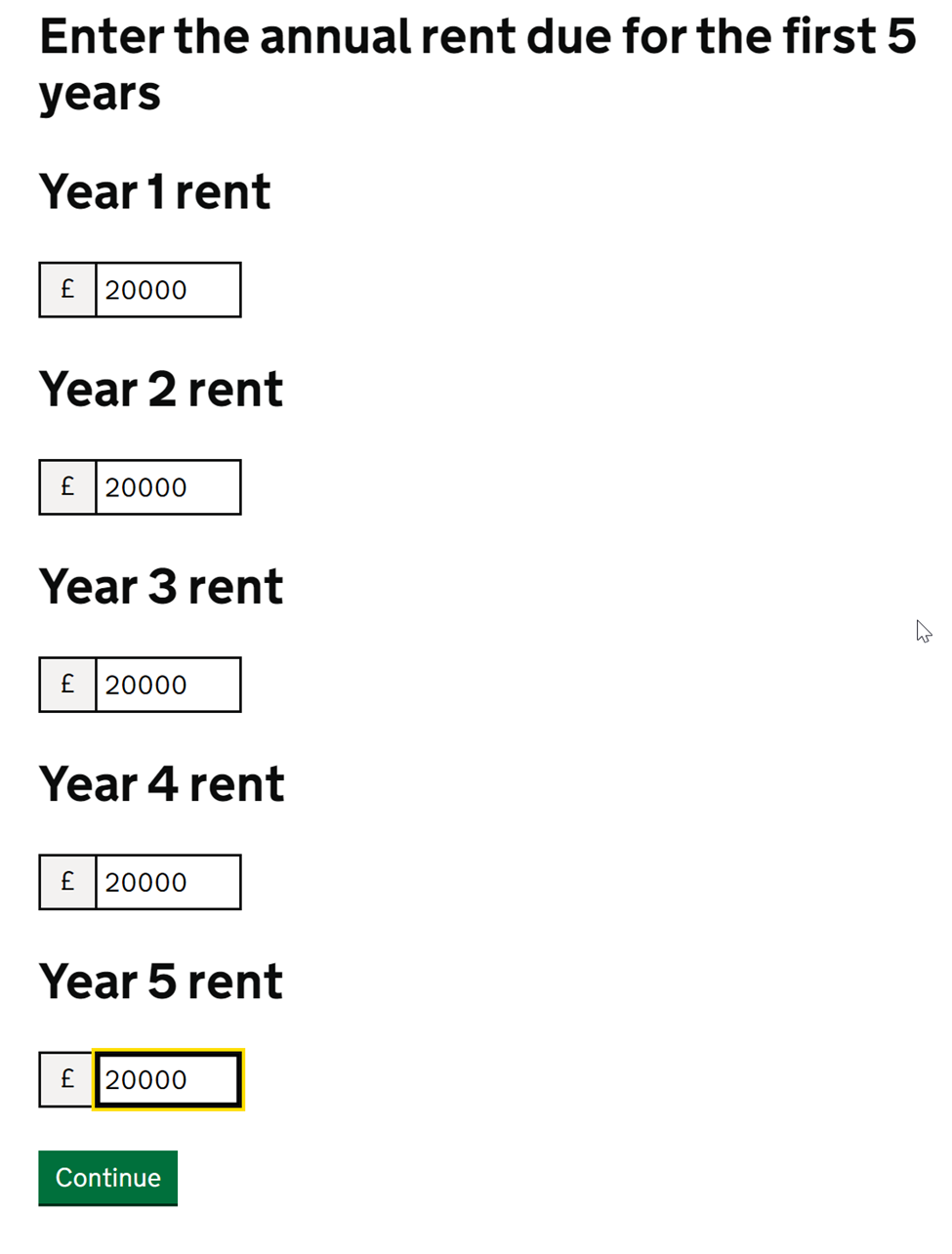
Enter Rent for the First Five Years:
- On the ‘Rent’ screen, enter the rent for the first five years. For example, £20,000 per year.
- Click ‘Continue’.
Calculation
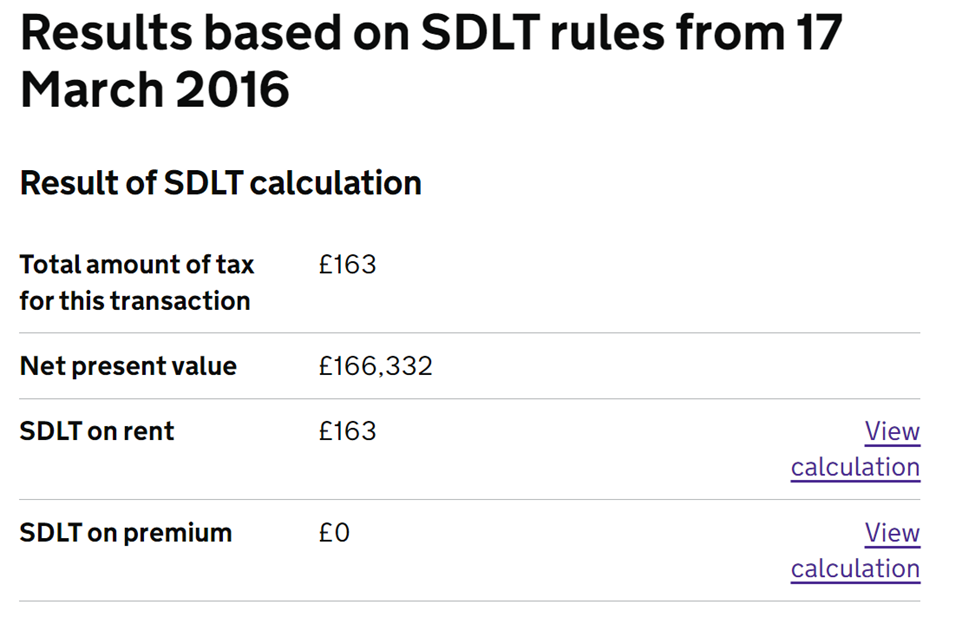
Additional Tips
- Double-Check Entries: Before finalising, double-check all entries to ensure there are no mistakes.
- Consult HMRC Guidance: If unsure about any aspect of the calculation, refer to the detailed guidance available on the HMRC website or consult with a tax professional.
- Save and Document: Always save a copy of the calculation results and document all related transactions and communications for future reference.
Using the HMRC SDLT calculator correctly can simplify the process of determining SDLT liability and ensure compliance with tax regulations.
—
Connected Company Rule
(SDLT and Leases>Calculating SDLT Liability)
➤ The connected company rule ensures that transactions between connected parties are taxed based on market values to prevent undervaluation and potential tax avoidance.
General Rule
- If the purchaser (the lessee or, in the case of a surrender, the landlord) is a company connected with the other party, the consideration is taken to be at least equal to the market value of the lease in question (Finance Act 2003, Section 53).
- The rule applies regardless of whether the vendor is a company, individual, or other entity.
- The rule’s application depends solely on the purchaser being a company connected with the vendor.
- This rule is subject to the same exceptions as apply to other transactions.
Application to Lease Grants
- When this rule applies to the grant of a lease, it does not lead to any deemed adjustment of the actual rent.
- If the rent charged under the lease is less than a full market rent, it is assumed that the lease will have a capital value.
- The amount of this capital value is taxed as a deemed premium.
Example: Lease to Connected Company
Scenario
- Date: 12 May 2022
- Grantor: John grants to his family trading company, Greenfield Enterprises Ltd.
- Property: A ten-year lease of a warehouse on his commercial property.
- Rent: The lease is at a flat rent of £10,000 per annum with no provision for rent reviews.
Analysis
- NPV of Rent: The Net Present Value (NPV) of rent over the life of the lease is clearly below the £200,000 threshold.
- Market Rent: It is acknowledged that a current market rent would be £40,000 per annum.
- Market Premium: A lease at the actual rent of £10,000 would command a market premium of £300,000.
SDLT Implications
- Deemed Premium: The lease is therefore subject to Stamp Duty Land Tax (SDLT) on this premium.
- SDLT Calculation: The SDLT chargeable is £1,500 (£150,000 at 0% plus £150,000 at 2%).
- Comparison: If the rent had been set at a market level of £40,000, the NPV of the rent would have been £399,498, and the SDLT payable would have been £1,498, almost the same as that payable based on the deemed premium.
- Filing and Payment: Greenfield Enterprises Ltd must file an SDLT return and pay the SDLT due of £1,500 by 26 May 2022.
Key Points
- The connected company rule ensures that transactions between connected parties are taxed based on market values.
- It prevents undervaluation and potential tax avoidance in property leases between connected entities.
- Companies must be diligent in filing and paying the correct amount of SDLT to avoid penalties.
By understanding these rules and implications, companies can better navigate property transactions with connected parties and ensure compliance with tax regulations.
—
Linked Transactions
(SDLT and Leases>Calculating SDLT Liability)
➤ Linked transactions between the same parties can combine for tax purposes, potentially raising total tax liability and require accurate reporting to avoid penalties.
Lease transactions can be ‘linked’ with other UK land transactions if they form part of a single scheme, arrangement, or series of transactions between the same vendor and purchaser or persons connected with them. This principle is outlined under FA 2003, s 108.
Conditions for Linked Transactions
There are two primary conditions under which lease transactions may be linked:
- Single Scheme or Arrangement
- Transactions are considered part of a single scheme if they are structured to achieve a common purpose or are interconnected.
- Example: If a lease for a commercial property in Manchester is followed by the lease of a related warehouse in Leeds, and both transactions are part of a business expansion plan, they may be considered linked.
- Series of Transactions
- Transactions form a series if they are sequential and connected by the parties involved or their associates.
- Example: A company leasing multiple office spaces in different cities over a few months to create a nationwide presence. These leases could be viewed as a series of transactions.
Implications of Linked Transactions
Understanding the implications of linked transactions is crucial for both vendors and purchasers:
- Tax Calculations
- When transactions are linked, the total consideration paid across all linked transactions is aggregated for tax purposes.
- This can result in higher tax liabilities as the aggregated value might push the transactions into a higher tax bracket.
- Reporting Requirements
- Linked transactions must be reported accurately, reflecting their interconnected nature.
- Failing to report linked transactions correctly can lead to penalties and interest charges from tax authorities.
Example Scenario
Consider the following example to illustrate linked transactions:
Scenario:
- Date: June 2024
- Vendor: Greenfield Properties
- Purchaser: BlueSky Enterprises
Transactions:
- Lease Agreement 1: Greenfield Properties leases a retail space in London to BlueSky Enterprises.
- Lease Agreement 2: Within the same financial year, Greenfield Properties leases a storage facility in Birmingham to BlueSky Enterprises.
Since both transactions involve the same vendor and purchaser and are part of BlueSky’s expansion strategy, they may be treated as linked transactions.
Key Takeaways
- Linked transactions can significantly impact tax liabilities.
- Accurate reporting of linked transactions is essential to avoid legal and financial penalties.
- Understanding the criteria for linking transactions helps in strategic planning and compliance with tax regulations.
—
Linked Transactions in Lease Agreements
(SDLT and Leases>Calculating SDLT Liability)
➤ Linked lease transactions, where leases are extended or linked together, require recalculating and potentially increasing SDLT payments to reflect the combined value over time.
Lease transactions may be linked with other UK land transactions if they form part of a single scheme, arrangement, or series of transactions between the same vendor and purchaser or connected persons. Here’s an in-depth look at the two distinct ways lease transactions can be linked and their implications:
Successive Linked Leases
When successive leases of substantially the same premises are granted and linked, each subsequent lease is treated as an extension of the earlier lease. This requires amendments to any SDLT (Stamp Duty Land Tax) returns previously made and payment of any additional SDLT due.
Example: Successive Linked Leases
- Initial Lease: On January 1, 2016, Rachel grants Mark a five-year lease of an office building for a premium of £100,000 and an annual rent of £40,000.
- Option for Extension: The lease includes an option for Mark to take a further five-year lease starting January 1, 2021, at the same rent, with an additional premium of £100,000.
- Exercise of Option: Mark exercises this option, and the second lease is executed on December 1, 2020, with the additional premium paid on January 1, 2021.
SDLT Implications:
- Initial Return: In January 2016, Mark submitted an SDLT return for the five-year lease, paying £2,000 in SDLT.
- Second Lease: A further SDLT return is required for the second lease.
- Linked Leases: The leases are linked, resulting in a deemed 10-year lease with a flat annual rent of £40,000 and a total premium of £200,000, commencing January 1, 2016.
- Recalculated SDLT: The SDLT on this 10-year lease is recalculated to be £8,900, with an additional £6,900 payable due to the second lease.
—
Other Linked Leases
(SDLT and Leases>Calculating SDLT Liability)
➤ Linked leases for different properties require recalculated SDLT based on combined values when part of a single deal, potentially increasing the tax owed.
Leases of different premises may be linked if negotiated as part of a single deal. For example, a tenant may take leases of two properties in different locations from the same landlord. When linked leases do not share the same effective date, the tax on the Total Net Present Value (TNPV) must be recalculated for each lease before applying the NPV/TNPV fraction.
Example: Non-Successive Linked Leases Calculation
- First Lease: On March 1, 2017, Emma takes a three-year lease on a retail shop with an annual rent of £30,000.
- Second Lease: On September 1, 2018, Emma takes another three-year lease on a different retail shop from the same landlord, with an annual rent of £20,000.
SDLT Implications:
- Initial Lease: The NPV of rent for the first lease is £85,095, with SDLT paid of £340.
- Second Lease: The NPV of rent for the second lease is £55,060.
- Aggregate NPV: The combined NPV of the linked leases is £140,155.
- Recalculated SDLT: The SDLT payable on a lease with this aggregate NPV is 1% of £(140,155 – 125,000), which is £151. The revised SDLT attributable to the first lease is £106, and the SDLT attributable to the second lease is £45.
As a stand-alone lease, the second lease would not have resulted in any SDLT charge. However, because it is linked with the first lease, an SDLT charge arises.
Key Principles of Linked Lease Transactions
- Single Scheme or Arrangement: Linked leases typically form part of a single scheme or arrangement between the same parties or connected persons.
- Amending SDLT Returns: When leases are linked, earlier SDLT returns must be amended to reflect the new, extended lease term.
- Recalculation of SDLT: SDLT must be recalculated based on the total NPV of linked leases, often resulting in additional SDLT liability.
- Consideration and Premiums: Any consideration or premiums paid in connection with the leases must be factored into the SDLT calculation.
—
Lease Renewals and Extensions
(SDLT and Leases>Calculating SDLT Liability)
➤ To determine SDLT for lease renewals, consider if the old lease had SDLT, overlaps between leases, agreements made, start dates, any gaps, and if leases are linked transactions.
Information Required for SDLT Consequences of Lease Renewal
To determine the Stamp Duty Land Tax (SDLT) implications of renewing a lease, the following questions need to be answered:
- Was the Old Lease Subject to Stamp Duty or SDLT?
- Identify if the previous lease was liable for stamp duty or SDLT.
- This determines the initial tax treatment of the lease.
- Did the New Lease Take Effect Before the Expiry of the Old Lease?
- Assess if there is an overlap between the old lease and the new lease periods.
- Determine if the new lease began before the old lease ended.
- Agreement for Lease
- Examine whether an agreement for the new lease was made and substantially performed before the formal execution of the new lease.
- Understand if the new lease terms were effectively in place before the official start date.
- Start Date of the New Lease
- Identify the official commencement date of the new lease.
- This date is crucial for calculating the SDLT due.
- Gap Between Old Lease and New Lease
- Determine if there was a period between the end of the old lease and the finalisation of the new lease agreement or its execution.
- Analyze the duration of any gap in occupation by the tenant.
- Duration of the Gap
- If there was a gap, ascertain if it was less than one year or more than one year.
- The length of this gap can affect the SDLT implications.
- Linking of Old and New Leases
- Check if the old and new leases are considered linked transactions.
- Linked transactions can influence the SDLT calculation.
Next Steps
The following sections and examples will explore the SDLT consequences for various combinations of answers to the above questions, providing clarity on how each scenario impacts the tax obligations.
—
SDLT and Lease Renewal
(SDLT and Leases>Calculating SDLT Liability)
➤ SDLT for lease renewals depends on whether the new lease overlaps the old lease and whether the leases are linked, with specific timing rules for SDLT obligations.
Old Lease under SDLT
New Lease Granted on or Before Expiry of Old Fixed-Term Lease
Timing and Execution of New Lease
If a new lease is stated to take effect immediately after the end of the old lease, and it is executed before or immediately upon the expiry of the old lease, the following conditions apply:
- The new lease must not be linked with the old lease
- SDLT (Stamp Duty Land Tax) is payable as if the new lease is a stand-alone lease, based on the term and consideration stated in the lease.
- If the new lease is linked with the old lease, this affects the calculation of SDLT but not the timing of SDLT obligations.
Reversionary Lease Considerations
If the new lease is executed before the end of the old lease, it is considered a reversionary lease (see SDLTM17070). Important points to consider regarding timing include:
- SDLT obligations arise 14 days after the date of execution of the new lease, not 14 days after the start date.
- This applies if the ‘effective date’ of the new lease is on or after 1 June 2020, or if the lease became notifiable on or after 1 June 2020.
- If the ‘effective date’ is before 1 June 2020, and the lease became notifiable before 1 June 2020, SDLT obligations arose 30 days after the date of execution of the new lease (Finance Act 2020, section 46(10)). See Example 6.23A.
Overlap Relief
If the new lease takes effect before the end of the old lease, credit may be available against the SDLT payable for the SDLT paid on the old lease for the overlap period.
—
Execution and SDLT Obligations
(SDLT and Leases>Calculating SDLT Liability)
➤ If a new lease is executed after the old lease expired, SDLT is due as if starting immediately after the last complete year of holding over, with different deadlines for SDLT obligations based on when the lease was notifiable.
New Lease Execution Timing
- If the new lease is executed after the old lease expired, and provided the latest complete year of holding over started on or after August 1, 2015, the new lease is treated for SDLT purposes as beginning immediately after the end of the last complete year of holding over (FA 2003, Sch 17A, para 3A(5)).
- No SDLT obligations arise for the final part year of holding over, but this part year is added to the new lease term for SDLT calculation.
SDLT Notification Requirements
- SDLT obligations for the new lease arise 14 days after the new lease commencement date, typically the execution date, provided the effective date of the grant is on or after March 1, 2019.
- If the new lease was notifiable before March 1, 2019, SDLT obligations arise 30 days after the new lease begins.
Historical Context
Leases Expiring Before August 1, 2015
- For leases that expired before August 1, 2015, and where the new lease started later than immediately after the old lease expired, the new lease was treated for SDLT purposes as beginning on the execution date or the stated start date, whichever was later.
- This resulted in a holding over period between the old lease expiry and the effective date of the new lease, handled as per section 6.13.
- Overlap relief was generally available for any part of a deemed one-year extension on which tax had been paid but not expired.
Changes Implemented by FA 2013
- The FA 2013 amendments simplified the process for leases expiring on or after August 1, 2015, and for holding over periods commencing on or after this date.
- The old rules continued to apply until August 1, 2016, for leases that expired up to a year before August 1, 2015, if new leases were still under negotiation.
—
SDLT on Old Leases
(SDLT and Leases>Calculating SDLT Liability)
➤ SDLT must be paid on a new lease as an independent lease, with obligations arising 14 days after execution if it begins before the old lease ends, and no SDLT credit is given for overlapping periods.
SDLT on Old Lease Termination
- SDLT (Stamp Duty Land Tax) must be paid on the new lease as if it were a completely independent lease.
- The term and consideration stated in the new lease are used to calculate SDLT.
- The old and new leases cannot be treated as linked for SDLT purposes.
- A major complication arises from the treatment of ‘rent’ for the period before the new lease’s effective start date, which is considered a premium.
New Lease Granted Before Expiry of Old Fixed-Term Lease
Execution Timing and SDLT Obligations
- If the new lease is executed before the expiration of the old lease, it is considered a reversionary lease.
- SDLT obligations arise 14 days after the execution date of the new lease, not after the start date.
- This rule applies if the ‘effective date’ of the new lease is on or after 1 June 2020, or if the lease became notifiable on or after this date.
- For new leases with an effective date before 1 June 2020, and those that became notifiable before this date, the SDLT obligations arose 30 days after execution.
No SDLT Credit for Overlap Period
- If the new lease begins before the old lease ends, no credit is available against the SDLT payable for any stamp duty paid on the old lease for the overlapping period.
Example Scenario
Case Study:
- Old Lease Expiry Date: 31 July 2023
- New Lease Execution Date: 1 July 2023
- New Lease Effective Date: 1 August 2023
In this example:
- The new lease is considered a reversionary lease since it was executed before the old lease expired.
- SDLT must be paid 14 days after the new lease’s execution date, i.e., by 15 July 2023.
- No SDLT credit is available for any stamp duty paid on the old lease covering the overlapping period in July 2023.
By adhering to these guidelines, you can ensure compliance with SDLT regulations and avoid any potential complications or penalties.
—
New Lease Granted After Expiry of Old Fixed-Term Lease
(SDLT and Leases>Calculating SDLT Liability)
➤ For SDLT purposes, a new lease starting immediately after an old lease is treated as starting on the old lease’s expiry date, with different rules and deadlines based on specific execution and start dates, and potential holding over periods up to one year.
Immediate Commencement of New Lease
When a tenant remains in occupation and the new lease is expressed to begin immediately after the old lease expires, it is treated as commencing on the expiry date of the old lease, regardless of when it is actually executed (FA 2003, Sch 17A, para 9A(2)). This differs from the treatment of a completely new lease, which cannot begin before the lease is executed.
Key Points:
- New lease commences on the expiry date of the old lease.
- The actual execution date does not alter the commencement date.
- This rule applies to leases as per FA 2003, Schedule 17A, paragraph 9A(2).
Example:
Old Lease Expiry: 1st January 2023 New Lease Start (Expressed): 1st January 2023 Execution Date: 15th January 2023. For SDLT purposes, the new lease starts on 1st January 2023.
Gap Between Expiry of Old Lease and Start Date of New Lease
Treatment for Leases Expiring on or After 17 July 2013
If the new lease starts within one year of the old lease’s expiry, it is treated as commencing immediately after the old lease expires (FA 2003, Sch 17A, para 3A(1)-(3)). Any holding over period (up to one year) before the new lease begins is added to the term of the new lease for SDLT purposes. No separate return is required for this holding over period.
Key Points:
- New lease must start within one year of old lease’s expiry.
- Holding over period is added to the term of the new lease.
- No SDLT return needed for the holding over period.
Example:
Old Lease Expiry: 1st January 2023 Holding Over Period: 6 months New Lease Start (Expressed): 1st July 2023 For SDLT purposes, the new lease term includes the 6 months of holding over.
Execution of New Lease Beyond One Year
If the new lease is executed more than a year after the old lease expires and is not expressed as beginning immediately after the old lease, any complete years of holding over will be treated separately. For leases expiring after 17 July 2013, the new lease starts immediately after the last complete year of holding over.
Key Points:
- New lease must be executed within one year to avoid complications.
- Any complete holding over years are treated separately.
- New lease begins after the last complete year of holding over if executed beyond one year.
Example:
Old Lease Expiry: 1st January 2023 Holding Over Period: 2 years New Lease Start (Executed): 1st February 2025 For SDLT purposes, the new lease starts immediately after the last complete year of holding over.
SDLT Obligations and Notification
Post-1 March 2019 Leases
The SDLT obligations arise 14 days after the new lease begins, assuming the effective date is on or after 1 March 2019.
Key Points:
- SDLT obligations due 14 days after new lease begins.
- Effective date on or after 1 March 2019.
Pre-1 March 2019 Leases
For leases notifiable before 1 March 2019, SDLT obligations arise 30 days after the new lease begins.
Key Points:
- SDLT obligations due 30 days after new lease begins for pre-1 March 2019 leases.
Historical Treatment for Leases Expiring Before 17 July 2013
Prior to FA 2013 Changes
For leases expiring before 17 July 2013, if the new lease started later than immediately after the old lease expired, it was treated as beginning on the execution date or the stated start date. Overlap relief was available for any part of a deemed one-year extension on which tax had been paid.
Key Points:
- New lease treated as beginning on execution date or stated start date.
- Overlap relief available for deemed one-year extension.
Summary of Key Dates and Rules
- After 17 July 2013: New lease can start within one year of old lease expiry without SDLT complications.
- Post-1 March 2019: SDLT obligations arise 14 days after new lease begins.
- Pre-1 March 2019: SDLT obligations arise 30 days after new lease begins.
- Before 17 July 2013: Old rules apply, overlap relief available, effective date complications.
This comprehensive overview covers the critical aspects of lease transitions and their SDLT implications, ensuring clarity for various scenarios and execution dates.
—
New Lease Superseding Old Lease for Indefinite Term
(SDLT and Leases>Calculating SDLT Liability)
➤ When a new lease replaces an old indefinite-term lease, the new lease is treated as a standalone lease for SDLT, and overlap relief may be claimed to avoid double taxation for any overlap period.
When a new lease is executed, superseding an old lease for an indefinite term, several key SDLT (Stamp Duty Land Tax) implications arise. Here is an expanded explanation using different names and dates:
Principles of the New Lease
- SDLT on New Lease:
- Standalone Lease: The new lease is treated as a simple standalone lease for SDLT purposes. The term of the lease commences on the date of execution, a later stated start date, or, if earlier, the date of substantial performance of any agreement for lease.
- Date of Substantial Performance:
- Definition: Substantial performance typically occurs when the tenant takes possession of the property or when a significant part of the rent or consideration is paid.
- Earlier Lease Occupation: Importantly, occupation of the property under the earlier indefinite-term lease does not cause substantial performance of the new lease agreement.
Overlap Relief
- Overlap Relief Claim:
- SDLT Paid on Old Lease: If SDLT was paid on the lease for an indefinite term and this period overlaps with the term of the new lease, it is possible to claim overlap relief. This relief applies to the portion of the term where the leases overlap.
- Overlap Relief Reference: For detailed guidance on claiming overlap relief, refer to section 6.83 of the Finance Act 2003.
Example Scenario
Scenario: On April 1, 2018, Emma entered into an indefinite-term lease for a retail shop. On January 1, 2024, Emma and the landlord executed a new five-year lease for the same property, commencing immediately.
- New Lease Execution:
- SDLT Liability: The new lease is subject to SDLT as a standalone lease starting on January 1, 2024.
- Substantial Performance: The new lease is not substantially performed by Emma’s prior occupation under the indefinite-term lease.
- Overlap Period:
- Overlap Calculation: Emma paid SDLT on the indefinite-term lease from April 1, 2018. Part of this period overlaps with the term of the new lease from January 1, 2024.
- Claiming Overlap Relief: Emma can claim overlap relief for the period from January 1, 2024, onwards, as it overlaps with the term of the new lease.
- Filing and Compliance:
- SDLT Return: Emma must submit an SDLT return for the new lease and include details of the overlap relief claim.
- Documentation: Proper documentation should be maintained to support the claim for overlap relief, ensuring that the SDLT paid on the indefinite-term lease is correctly accounted for.
Conclusion
When a new lease supersedes an old lease for an indefinite term, the new lease is treated as a standalone lease for SDLT purposes, starting from the date of execution or substantial performance. Overlap relief can be claimed for periods where SDLT was previously paid on the indefinite-term lease, preventing double taxation. Proper understanding and application of these principles help ensure compliance with SDLT regulations and optimise tax obligations.
—
New Lease Superseding Old Lease for Indefinite Term
(SDLT and Leases>Calculating SDLT Liability)
➤ The new lease is treated as a standalone for SDLT, beginning on its execution or substantial performance date, and overlap relief can be claimed if SDLT was paid on the old overlapping indefinite-term lease.
Key Points
Execution and Start Date:
- The new lease is subject to Stamp Duty Land Tax (SDLT) as an independent lease.
- It begins on the date of execution, a specified later start date, or the date of substantial performance of any lease agreement.
Substantial Performance:
- The occupation of the property under the earlier indefinite term lease does not trigger substantial performance for the new lease.
Overlap Relief:
- If SDLT has already been paid on the indefinite term lease for a period overlapping with the new lease term, you may be eligible to claim overlap relief for that period.
–
Execution and Start Date. Commencement of the New Lease
The new lease, which replaces the old indefinite term lease, will be subject to SDLT as a distinct lease agreement. This lease’s term starts on one of the following dates:
- Date of Execution: The day when the new lease is officially signed.
- Later Stated Start Date: A future date specified within the lease agreement.
- Date of Substantial Performance: The date when substantial performance of any related agreement for lease occurs, if this is earlier than the above dates.
Substantial Performance. Impact of Previous Lease Occupation
It’s important to note that occupying the property under the prior indefinite term lease does not equate to substantial performance of the new lease agreement. This distinction ensures that the new lease is treated independently for SDLT purposes, preventing any confusion regarding tax liabilities based on prior occupation.
Overlap Relief. Claiming Overlap Relief
In cases where SDLT has been paid for the previous indefinite term lease for a period that also falls within the new lease term, it is possible to claim overlap relief. Overlap relief can be sought for the part of the period that is covered by both leases, potentially reducing the SDLT liability for the new lease.
—
Stamp Duty Land Tax (SDLT) on New Leases
(SDLT and Leases>Calculating SDLT Liability)
➤ SDLT on a new lease is calculated separately from any old lease, based on the lease term and rent, and pre-start date rent is treated as a premium that can affect the SDLT amount.
SDLT on New Leases
When a new lease is granted, SDLT is payable as if it were a separate, standalone lease based on the term and consideration specified in the lease agreement. The new lease must be treated independently and cannot be linked to the old lease.
Key Points to Consider:
- Term and Consideration: SDLT is calculated based on the lease term and the financial consideration (e.g., rent and any other payments) stated in the new lease.
- Independent Treatment: The new lease is treated as an entirely new contract for SDLT purposes, without any connection to the previous lease.
Complications with Rent
One significant complication arises when rent is paid for a period before the official start date of the new lease. In such cases, this rent is treated as a premium, which can impact the SDLT calculation.
Important Considerations:
- Pre-Start Date Rent: Rent paid before the new lease’s effective start date is considered a premium.
- Premium Treatment: This treatment affects how SDLT is calculated, potentially increasing the amount due.
–
Example Scenario
Lease Details
- Old Lease Expiry: December 31, 2023
- New Lease Start Date: January 1, 2024
- Term of New Lease: 5 years
- Annual Rent: £20,000
SDLT Calculation
- Term and Consideration: SDLT is calculated on the term (5 years) and annual rent (£20,000).
- Independent Lease: The new lease is treated as a new agreement, separate from the old lease.
- Pre-Start Rent as Premium: If rent is paid for any period before January 1, 2024, this amount is treated as a premium and added to the SDLT calculation.
Conclusion
When entering into a new lease, it is crucial to understand that SDLT is calculated independently of any previous lease. Any rent paid before the new lease’s effective start date is treated as a premium, which can complicate the SDLT calculation. Ensure all terms and considerations are clearly stated in the new lease to avoid unexpected SDLT liabilities.
—
Grant of New Lease Before Expiry of Old Lease
(SDLT and Leases>Calculating SDLT Liability)
➤ If a new lease is granted before the old one expires, it is a reversionary lease, and SDLT is due 14 days after execution, with no credit for the overlap period.
When a new lease is granted before the old fixed-term lease expires, several important considerations come into play. These considerations are crucial for understanding the timing and obligations related to Stamp Duty Land Tax (SDLT).
Key Points to Consider:
- Reversionary Lease: If the new lease is executed before the old lease ends, the new lease is considered a reversionary lease.
- Timing of SDLT Obligations: SDLT obligations arise 14 days after the execution date of the new lease, not the start date. This is a critical timing aspect for compliance.
Effective Date and Notification:
- After 1 July 2022:
- If the effective date of the new lease is on or after 1 July 2022, or the new lease only became notifiable on or after this date, SDLT obligations must be met within 14 days of the execution date.
- Before 1 July 2022:
- If the effective date is before 1 July 2022 and the new lease was notifiable before this date, the SDLT obligations arose 30 days after the execution date.
No SDLT Credit for Overlap Period:
- Overlap Period: If the new lease takes effect before the old lease ends, no credit is available against the SDLT payable for any stamp duty paid on the old lease during the overlap period.
Example:
Consider a scenario where a new lease is executed on 15 February 2023, with the old lease ending on 31 March 2023. The SDLT obligations for the new lease will arise 14 days after 15 February 2023, irrespective of the start date of the new lease. If the effective date was before 1 July 2022, the SDLT obligations would have arisen 30 days after the execution date.
By following these guidelines, tenants and landlords can ensure they meet their SDLT obligations in a timely manner and avoid potential penalties.
—
New Lease Granted After Expiry of Old Fixed-Term Lease
(SDLT and Leases>Calculating SDLT Liability)
➤ If a new lease is granted after the old lease expires, SDLT applies from the execution or substantial performance date, and any prior rent is treated as a premium if above thresholds.
Continuation of Old Lease
- If a tenant remains in occupation and continues to pay rent after the expiry of a fixed-term lease, this period is treated as a continuation of the old lease.
- No Stamp Duty Land Tax (SDLT) obligations arise during this holding over period.
Commencement of New Lease
- The new lease is considered to begin on the date it is executed or “substantially performed,” whichever comes first.
- A payment of rent under the new lease is regarded as substantial performance.
- The lease is not considered substantially performed merely because the tenant is in occupation or possession under the deemed continuation of the old lease.
Retroactive Lease Start Dates
- The lease may be expressed as starting earlier than the date of execution or substantial performance.
- Since the old lease was not subject to SDLT, the general rule applies, and the lease is not treated as beginning earlier than the execution or substantial performance date.
- Any rent reserved under the new lease for a period before the deemed start date is treated as a premium.
- Such amounts are often small and below the SDLT thresholds:
- £125,000 for residential property
- £150,000 for non-residential or mixed-use property
Exceptional Circumstances
- Actions taken before the new lease agreement, which could be regarded as a surrender and re-grant (e.g., significant changes to the premises or an explicit agreement to extend the lease for a further fixed term), may be regarded as the grant of a new lease for SDLT purposes.
- In such cases, it is advisable to seek further legal advice based on a detailed analysis of the specific situation.
Increase in Rent
- An increase in rent paid during the holding over period, even if not provided for in the old lease, will not normally result in a new deemed lease for the period in question.
—
Lease Examples
(SDLT and Leases>Calculating SDLT Liability)
➤ If a new lease for ServiceWorks is negotiated before the old lease expires, with an annual rent of £120,000, the SDLT of £5,837 is based on a 1 January 2024 start, and payment is due within 14 days of 1 December 2023.
ServiceWorks occupies a commercial unit under a lease from an unrelated entity, RealtyCorp. When the original lease was granted over five years ago, there was no agreement between the parties regarding renewal, and the lease did not include any option to renew. The lease expires on 31 December 2023, with the annual rent being £100,000 including VAT. A new lease is negotiated with the following commercial terms:
- Duration: Seven years starting from 1 January 2024
- Annual rent: £120,000 including VAT
- No separate premium payable
- Rent review scheduled for 1 January 2029
Example: Lease Renewal – New Lease Executed Prior to Expiration
Key Dates and Details
- Old Lease Expiration: 31 December 2023
- New Lease Execution Date: 1 December 2023
- New Lease Effective Date: 1 January 2024
Financial Details
- Annual Rent: £120,000 including VAT
- Net Present Value (NPV) of Rent: £733,745 (as per HMRC calculator)
- Stamp Duty Land Tax (SDLT) Payable: £5,837
Important Considerations
- The rent review will not occur during the first five years of the lease, so it can be ignored in the SDLT calculation.
- The calculation of SDLT is based on the lease commencement date of 1 January 2024.
- Because the new lease was executed on 1 December 2023, the SDLT return and tax payment are due within 14 days of this date, which is by 15 December 2023, before the lease period commences.
Additional Notes
- It does not matter whether the old lease was subject to stamp duty or SDLT, unless the leases could be regarded as linked, which would require a different consideration (see Section 6.58 for linked leases)





